
The Val d'Orcia, Italy: A Travel Guide | Highlights, How to Get There and When to Go

Living in Japan and dreaming of cycling in Italy? Cicloposse Japan, based in Okayama, is the Japan-side partner of Cicloposse Italia. Contact us to start planning your tour.

From the basics to the highlights, how to get there and the best time to visit: here is the Val d'Orcia, introduced by me, an Italian.
When I first visited the Val d'Orcia, what struck me most was the number of hills and the intensity of nature's colours. That sense of scale doesn't come through in photos. Hills upon hills wherever you look. And the colours change completely with the seasons: vivid green in spring, gold in autumn. The same place shows you a completely different face. I'd love for as many people living in Japan as possible to experience that feeling.
Nice to meet you. My name is Matteo. I'm Italian, born in Milan, and I now live in Okayama, Japan. I run an Italian restaurant in Okayama and, as a bridge between Italy and Japan, I help people in Japan discover travel in Italy.
The tours I offer are run by Cicloposse, a cycling tour operator based in Tuscany. Drawing on my experience of visiting, riding the local roads and tasting the food, in this blog I share the charm of the Val d'Orcia.
Enjoy some insider tips you won't find in guidebooks, the kind only locals know.
What is the Val d'Orcia? A World Heritage site in Tuscany, Italy
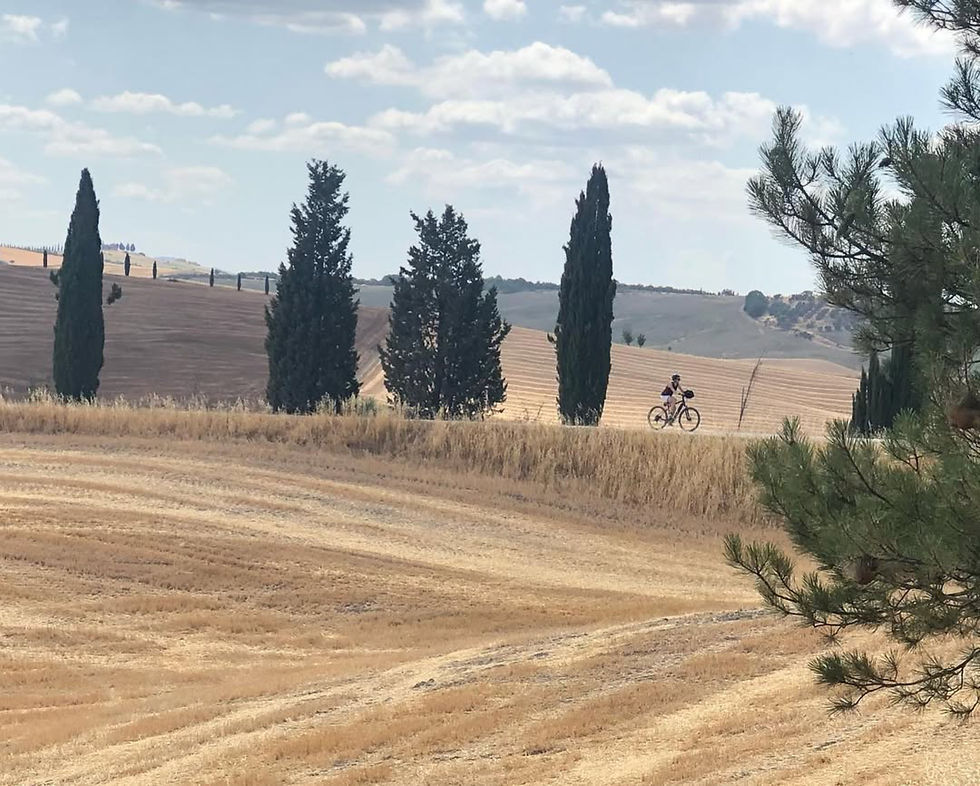
The Val d'Orcia, in Tuscany, is a beautiful stretch of countryside with gentle hills, cypress trees and vineyards. Its landscape is listed as a UNESCO World Heritage site and is one of the most scenic areas in Tuscany.
Val means valley, and d'Orcia comes from the Orcia river. The rural landscape has barely changed since the Middle Ages, and the views look just like the backgrounds of Renaissance paintings. This is a quiet, deep Italy, very different from city destinations like Florence or Siena.
Where is the Val d'Orcia?
The Val d'Orcia lies in southern Tuscany, in the province of Siena. It is about 50 km south of Siena, about 120 km from Florence and about 200 km north of Rome.
At the heart of the valley are small towns such as Montalcino, Pienza, San Quirico d'Orcia and Radicofani. The Orcia river runs between these villages, linked by a network of white gravel roads, the strade bianche.
The nearest major city is Siena, and you can visit the area on day trips from there. But to really feel the magic of the valley, I recommend staying at least two or three nights.
How to get to the Val d'Orcia
There are several ways to reach the Val d'Orcia from Siena.
Rental car: the option I recommend most. From Siena, head south on the SS2 (Via Cassia) and turn off depending on your destination. It takes about 1 to 1.5 hours.
Bus: Tiemme buses run from Siena's bus station to some villages, but services are infrequent and getting from village to village is difficult.
Taxi or private driver: you can also book a private transfer from Siena. It costs more, but it's convenient if you have lots of luggage or want flexibility.
Train: the nearest station is Chiusi, on the main line between Rome and Florence. From there, continue to the villages by car or taxi.
In my personal opinion, a rental car is by far the best way to get around the Val d'Orcia. Buses are limited, which makes it hard to enjoy what this area is all about: stopping wherever you like. Be aware, though, that parking can be tricky in the narrow centres of the villages.
Highlights and best viewpoints of the Val d'Orcia
Beyond its beautiful rolling landscape, the Val d'Orcia is dotted with historic towns and villages, wine country and ancient hot springs. Here are the viewpoints and places you shouldn't miss when you visit.
Pienza

Of all the towns in the Val d'Orcia, Pienza is the one closest to my heart. It was designed in the 15th century, during the Renaissance, by Pope Pius II as an ideal city, and its harmonious streets are a UNESCO World Heritage site in their own right.
Narrow cobbled lanes, small squares, little shops selling local produce. Pienza's charm lies in its small size. It isn't overly touristy, and local daily life still goes on here. In fact, my former maths teacher came from Pienza, so the town holds a special place in my heart.
One thing you must try here is pecorino di Pienza, a cheese made from the milk of locally raised sheep, with completely different flavours depending on how long it's aged. In the small local shops you'll also find souvenirs like olive oil, herbs and T-shirts printed with the wild boar, a symbol of Tuscany.
On our tour we stop in Pienza as we ride through, but if you come on your own, early morning is best. There are fewer tourists, and Piazza Pio II in the morning light is something special.
Montalcino

Montalcino is a hilltop town famous as the home of Brunello di Montalcino, one of the world's finest wines. At 564 m above sea level, it enjoys a perfect position overlooking the Val d'Orcia.
From the 14th-century fortress (Fortezza), you can take in the whole of the Val d'Orcia. Riding towards Montalcino, the silhouette of the fortress appearing on the hilltop is unforgettable. The enoteca inside the fortress also offers Brunello by the glass.
If you love wine, I recommend booking a winery tour in advance. Walk among the Sangiovese vines, see how the wine ages in the cellar and enjoy a tasting: that alone makes Montalcino worth the visit. On our tour we visit the Fanti winery and taste Brunello over lunch.
San Quirico d'Orcia
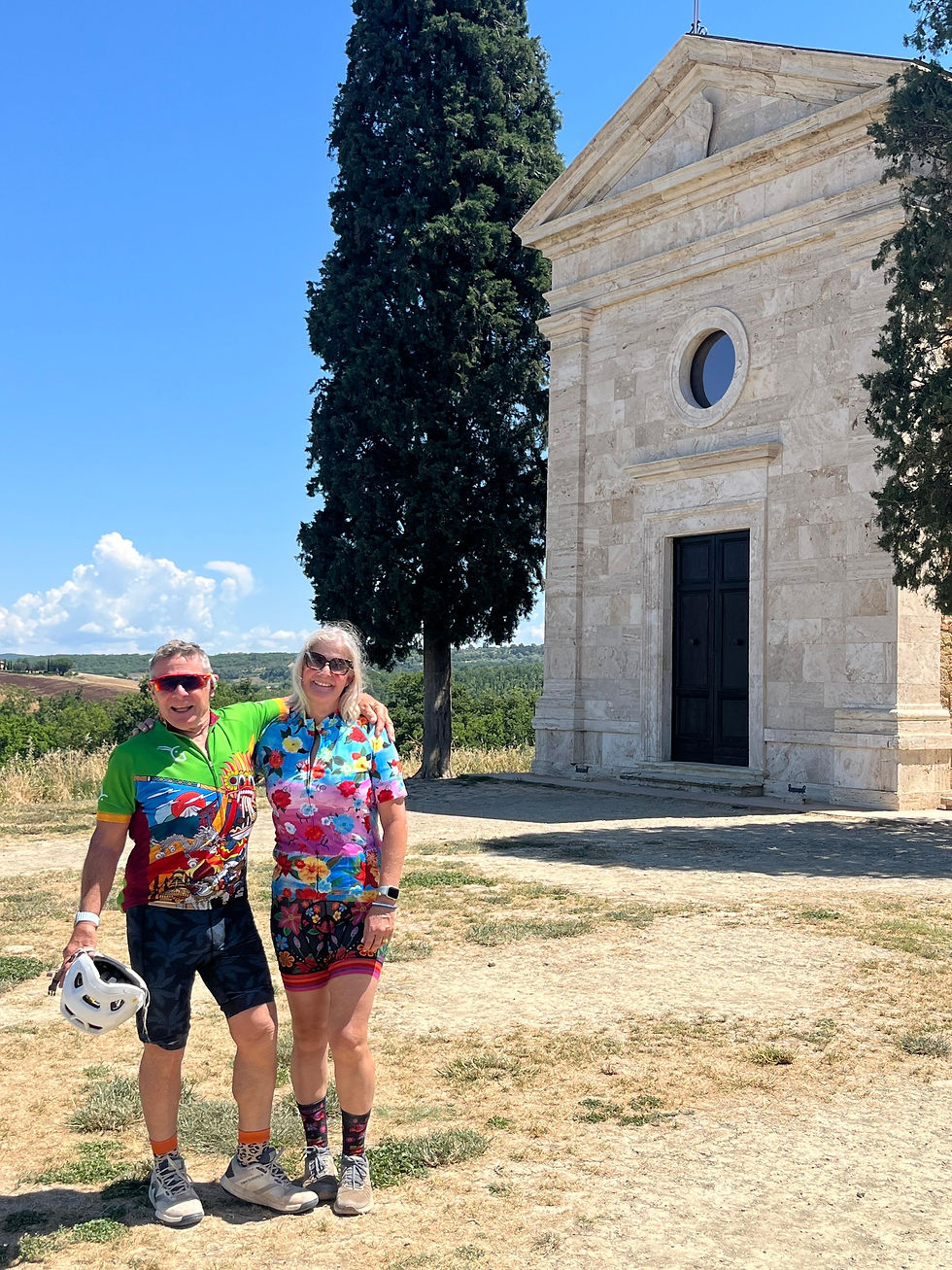
San Quirico d'Orcia is one of the quietest, most relaxed villages in the Val d'Orcia. As you ride up to the edge of the village, you immediately feel a calm that tourism hasn't touched. It's a place where everyday Tuscan life is still real.
Highlights include the 12th-century Collegiata and the Horti Leonini garden next to it. Geometrically clipped hedges and locals taking their time: it feels as if time moves differently here.
In the centre of the village there are a few small cafés and trattorias. Sipping an espresso on a terrace and simply doing nothing: that, to me, is the right way to enjoy San Quirico.
The thermal village of Bagno Vignoni
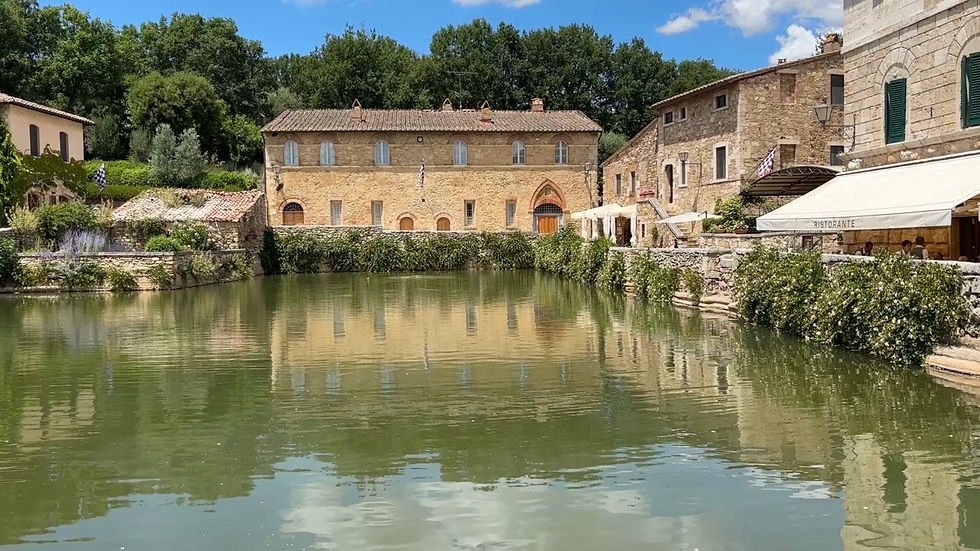
Bagno Vignoni is a rare thing even in Italy: a village with a hot spring in its main square. The large stone basin at the centre of the village is still filled with thermal water. People once bathed here, but today bathing is forbidden to protect the site. On Cicloposse tours, you can visit thermal facilities around the village and actually bathe there.
Still, its unique scenery remains. Looking at the square, surrounded by stone buildings and wrapped in steam from the spring, is an experience like no other. Knowing Japan's onsen culture, I find it fascinating that Italy has its own culture of hot springs too.
There are also spa facilities around the village where you can enjoy thermal waters surrounded by nature. On our tour we ride to Bagno Vignoni and take a break in the thermal square. Watching the steam rise after a sweaty ride is a special moment.
The best time to visit the Val d'Orcia

When you visit the Val d'Orcia really matters. To be honest, there are times to avoid, and there are seasons that will make you truly glad you came.
Spring (April to June): our top pick
Spring is the most beautiful season in the Val d'Orcia. The hills are covered in lush green, and red poppies fill the fields. This green is a little different from the green in Japan: deeper and stronger. The air is clear, and riding a bike here feels as if it cleans you right down to your lungs. May in particular has mild temperatures and perfect cycling conditions.
In June the days get longer, with light until almost 9 pm. The Val d'Orcia at dusk is beautiful beyond words, and sometimes the sky is still glowing red after dinner. These long evenings feel to me like a uniquely Italian luxury.
Autumn (September to October): the wine season
From mid-October temperatures start to drop, but the Val d'Orcia in clear autumn light has a beauty all its own.
Summer (July to August): best avoided
Honestly, I don't recommend July and August. Temperatures above 35°C are not unusual, which is far too harsh, especially for cycling. This is also when Italian holidaymakers arrive in large numbers, so the small villages get crowded.
If you have to come at this time, I recommend a siesta style: be active early in the morning and rest during the day.
Winter (November to March): almost too quiet
In winter there are almost no tourists in the Val d'Orcia, and the villages fall silent. Cypresses rising out of the fog make for magical scenery, but many restaurants and wineries are closed and the weather is unpredictable, so it's not an easy time for sightseeing.
Where to stay in the Val d'Orcia

My top recommendation for staying in the Val d'Orcia is an agriturismo (farm stay). Across Tuscany, many old farmhouses, farms and cantinas (wine cellars) have been carefully restored and reborn as places to stay.
This transformation from rural farm to guest accommodation is what makes staying in the Val d'Orcia special. Sleeping in a space like a small village, rather than a hotel, is a completely different experience from a city hotel. Stone buildings, vast grounds and the hills right in front of you: that's the charm of an agriturismo.
As areas to stay, I recommend the surroundings of Montalcino and Pienza. Both have good access to the main sights and wonderful scenery.
On Cicloposse cycling tours, our base for all six nights is La Pieve di Palazzo Massaini, a villa set in the beautiful countryside of the Val d'Orcia. This carefully restored old farmhouse also has an infinity pool. After a day of cycling, resting by the pool while looking out over the valley: that rhythm makes the trip even richer.
Exploring the Val d'Orcia: by bike or by car?

Both a rental car and a bike have their advantages for getting around the Val d'Orcia. The best choice depends on your goals and fitness, but let me share my honest view from personal experience.
Rental car
A rental car gives you lots of freedom and suits you if you have plenty of luggage or worry about your fitness. Moving from village to village is efficient too. But from a car, you only experience the scenery through the window.
Keep in mind that Italian country roads are often narrow, and finding parking can be difficult, especially in village centres. And when you're concentrating on driving, it's hard to focus on the views.
Bike
A bike lets you take in the landscape slowly, with all your senses. Ride through the Val d'Orcia and you'll notice things you'd never see from a car.
The colour of the hills changing in the morning light, the sound of tyres on gravel, the scent of olives carried on the wind: you can't feel these things from inside a car. And the strade bianche (white gravel roads) only reveal their true value by bike. The scenery changes a little every day, and it's the speed of a bike that lets you notice it.
Even if you're worried about your fitness, an e-bike (pedal-assist electric bike) lets you ride the hills with ease. On Cicloposse tours, a support van is always with the group, so you can take a break whenever you're tired. Luggage transfers are included on both guided and self-guided tours, so you can ride light even on days when you change hotels.
Cycling tours through the Val d'Orcia

Cicloposse's Tuscany Cycling & Cooking tour is a seven-day guided tour based in the Val d'Orcia. You'll ride to most of the places in this article, including Pienza, Montalcino, Bagno Vignoni and Radicofani.
It's not just about cycling: there are Tuscan cooking classes with chef Paolo, winery tours and dinners with local ingredients.
Final thoughts
The Val d'Orcia is a place you'll never forget once you've been. When the scenery you've seen in photos opens up before your eyes, you feel it: this is the real thing.
My personal favourites are the cobbled lanes of Pienza and the thermal square of Bagno Vignoni. Both capture the essence of Italy, and you'll lose track of time there.
Choose spring or autumn for your visit. The heat of July and August is too much, especially if you want to be active. And if you can, try travelling by bike. You'll see the true Val d'Orcia, the side you'd never notice from a car.
If you have any questions, feel free to contact us anytime.
I look forward to meeting you in Tuscany.
Matteo


Comments